Fibonacci Sequence in C — From Nature to Code
The Fibonacci sequence appears everywhere — in the spiral of a nautilus shell, the arrangement of sunflower seeds, and even the branching of trees. In programming, it is the classic gateway to understanding recursion, base cases, and why naive solutions can hide exponential costs.
The Mathematical Definition
The Fibonacci numbers are defined by a recurrence relation:
\[F_0 = 0, \quad F_1 = 1\] \[F_n = F_{n-1} + F_{n-2} \quad \text{for } n > 1\]Each element is the sum of the two preceding elements. Simple to state — but surprisingly deep in its consequences.
Visual Intuition: The Recursion Tree
When you call fibonacci(5), the call stack builds a tree of function calls. Watch how the same sub-problems are solved over and over again:
                    fib(5)
                /      \
            fib(4)        fib(3)
            /      \       /      \
        fib(3)    fib(2) fib(2)   fib(1)
        /      \   /   \   /   \
    fib(2)  fib(1) fib(1) fib(0) fib(1) fib(0)
    /    \
fib(1)  fib(0)
| Color | Meaning |
|---|---|
🟢 fib(1), fib(0) |
Base cases — these stop the recursion |
🟡 fib(2), fib(3), fib(4) |
Recursive calls — computed multiple times! |
Notice that fib(3) is calculated twice, and fib(2) is calculated three times. This redundant work is why the naive recursive approach becomes unbearably slow as $n$ grows.
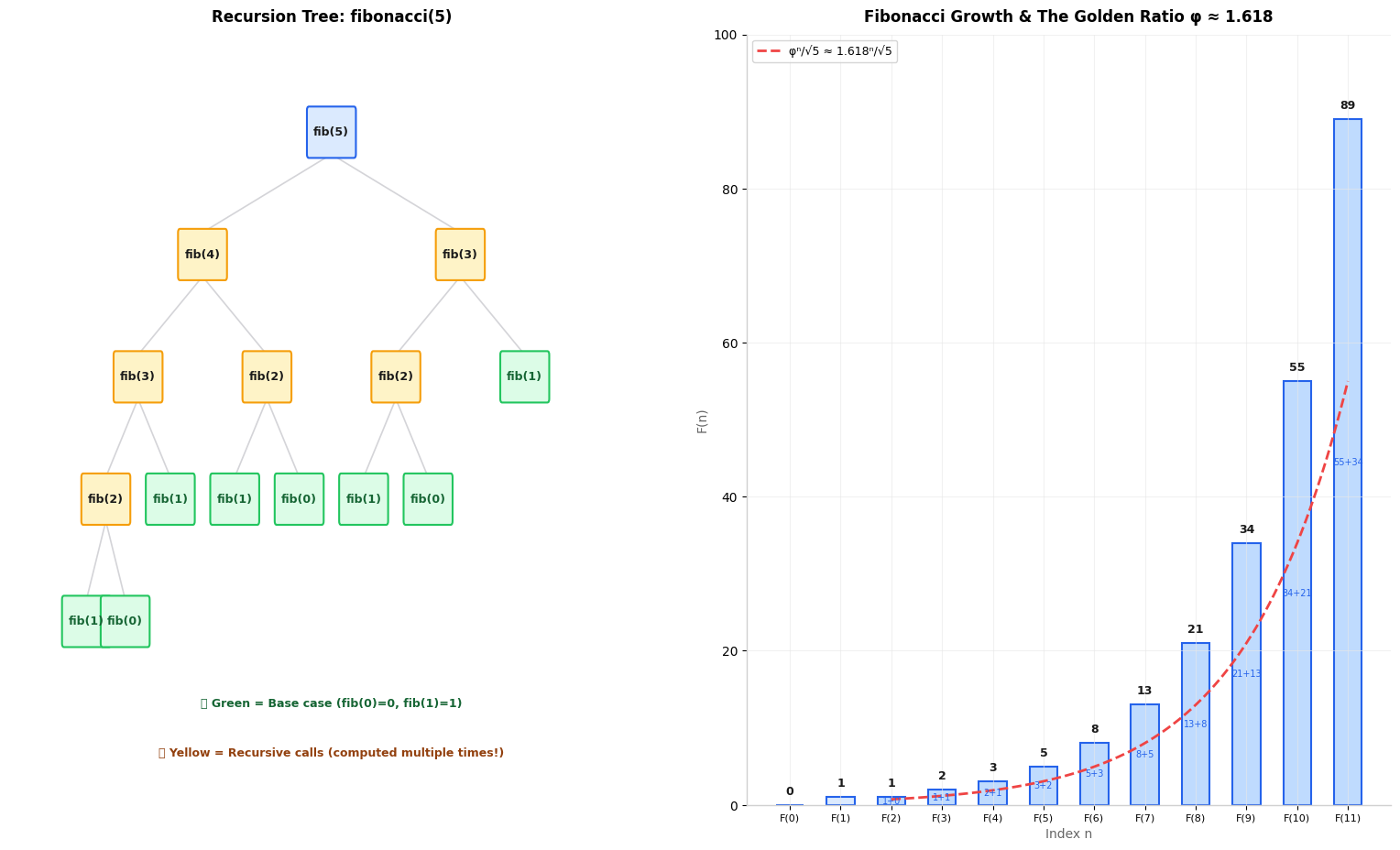 Left: The recursion tree for
 fibonacci(5) shows redundant calls. Right: Fibonacci growth closely tracks the golden ratio $\phi^n / \sqrt{5}$.
Why This Works
A recursive function needs three things to succeed:
-
A problem that breaks into smaller versions of itself
Finding $F_n$ requires finding $F_{n-1}$ and $F_{n-2}$ — smaller Fibonacci numbers. -
Base cases that stop the recursion
Withoutif (n == 0) return 0;andif (n == 1) return 1;, the function would call itself forever, causing a stack overflow. -
A guarantee of progress toward the base cases
Each recursive call reduces $n$, so we eventually reach 0 or 1.
The C Code
Here is the classic recursive implementation:
#include <stdio.h>

// Function declaration
int fibonacci(int n);

int main() {
    int n = 10;

    printf("First %d Fibonacci numbers:\n", n);
    for (int i = 0; i < n; i++) {
        printf("%d\t", fibonacci(i));
    }
    printf("\n");

    return 0;
}

// Recursive Fibonacci: F(n) = F(n-1) + F(n-2)
int fibonacci(int n) {
    // Base cases: stop the recursion
    if (n == 0) {
        return 0;
    }
    if (n == 1) {
        return 1;
    }

    // Recursive step: break into smaller problems
    return fibonacci(n - 1) + fibonacci(n - 2);
}
Expected Output
First 10 Fibonacci numbers: 0 1 1 2 3 5 8 13 21 34
The Hidden Cost: Why Recursion Is Slow
The recursive solution looks elegant, but its time complexity is $O(2^n)$. This is because each call spawns two more calls, leading to an explosion of redundant work.
| $n$ | Recursive Calls | Iterative Steps | Recursive Time |
|---|---|---|---|
| 5 | 15 | 5 | ~0.001 ms |
| 10 | 177 | 10 | ~0.01 ms |
| 20 | 21,891 | 20 | ~10 ms |
| 30 | 2,692,537 | 30 | ~1 second |
| 40 | 331,160,281 | 40 | ~2 minutes |
| 50 | ~40 billion | 50 | ~2.5 years* |
*Extrapolated. In practice, your program would crash from a stack overflow long before finishing.
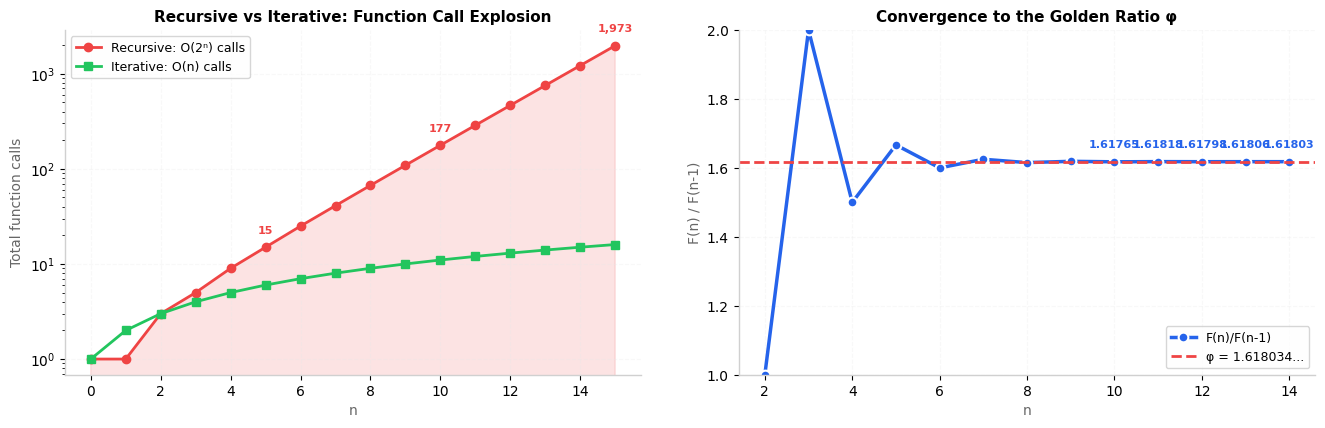 Left: The recursive approach explodes exponentially while iterative stays linear. Right: The ratio $F(n)/F(n-1)$ converges to the golden ratio $\phi \approx 1.618$.
Iterative Version (No Recursion)
For any real-world use, use a for loop instead. It runs in $O(n)$ time with $O(1)$ memory:
#include <stdio.h>

int main() {
    int n = 10;

    printf("First %d Fibonacci numbers (iterative):\n", n);

    long long prev2 = 0;  // F(0)
    long long prev1 = 1;  // F(1)

    printf("%lld\t%lld\t", prev2, prev1);

    for (int i = 2; i < n; i++) {
        long long current = prev1 + prev2;  // F(i) = F(i-1) + F(i-2)
        printf("%lld\t", current);

        // Shift the window forward
        prev2 = prev1;
        prev1 = current;
    }
    printf("\n");

    return 0;
}
Output:
First 10 Fibonacci numbers: 0 1 1 2 3 5 8 13 21 34
Both versions produce the same result, but the iterative one:
- Uses constant memory (no call stack growth)
- Runs in linear time $O(n)$ instead of exponential $O(2^n)$
- Can handle $n = 10,000$ without breaking a sweat
The Golden Ratio Connection
As $n$ grows large, the ratio of consecutive Fibonacci numbers approaches the golden ratio:
\[\phi = \frac{1 + \sqrt{5}}{2} \approx 1.6180339887...\]This gives us Binet’s closed-form formula — no recursion needed:
\[F_n = \frac{\phi^n - (1-\phi)^n}{\sqrt{5}}\]In C, you could compute this directly with <math.h>, though floating-point precision limits its accuracy for large $n$.
Real-World Connections
| Domain | How Fibonacci Appears |
|---|---|
| Nature | Petal counts, pinecone spirals, nautilus shells, branching patterns |
| Finance | Fibonacci retracement levels in technical stock analysis |
| Algorithms | Introduces memoization, dynamic programming, and recurrence relations |
| Art & Design | Golden ratio proportions in architecture and visual composition |
| Computer Science | Analysis of recursive algorithms and the call stack |
Try It Yourself
- Scale test: Modify the code to print the first 20 Fibonacci numbers. At what value does a 32-bit
intoverflow? (Hint: check $F_{47}$) - Performance test: Time the recursive version for
n = 40andn = 45. Why does it get so much slower? - Iterative rewrite: Convert the recursive function to use a for loop with an array to store values.
- Memoization bonus: Use an array to cache previously computed values. Compare the speedup against the naive recursive version for
n = 40. - Golden ratio: Compute $F_{30} / F_{29}$ in your calculator. How close is it to $\phi$?