Matrix Multiplication in C — A Visual Guide
Matrices aren’t just grids of numbers — they’re the language of linear algebra, powering everything from video games to AI neural networks. Let’s learn matrix multiplication from the ground up.
What is a Matrix?
A matrix is a rectangular array of numbers arranged in rows and columns. An $m \times n$ matrix has $m$ rows and $n$ columns.
\[A = \begin{bmatrix} 1 & 2 & 3 & 4 \\ 5 & 6 & 7 & 8 \\ 9 & 10 & 11 & 12 \\ 13 & 14 & 15 & 16 \end{bmatrix} \quad \text{(a 4×4 matrix)}\]Each element is identified by its row and column indices: $A_{i,j}$ is the element at row $i$, column $j$.
The Dot Product
Before multiplying matrices, you need to understand the dot product.
Given two vectors of the same length, the dot product multiplies corresponding entries and sums them:
\[\vec{a} \cdot \vec{b} = \sum_{k=0}^{n-1} a_k \cdot b_k = a_0b_0 + a_1b_1 + \cdots + a_{n-1}b_{n-1}\]For example: \(\begin{bmatrix} 1 & 2 & 3 & 4 \end{bmatrix} \cdot \begin{bmatrix} 1 \\ 1 \\ 1 \\ 1 \end{bmatrix} = 1(1) + 2(1) + 3(1) + 4(1) = 10\)
Matrix Multiplication Rule
To multiply $A \times B$:
- Check dimensions: $A$ must be $m \times k$ and $B$ must be $k \times n$. The inner dimensions ($k$) must match!
- Result: The product $C = A \times B$ will be $m \times n$.
- Each element: $C_{i,j}$ = dot product of row $i$ of $A$ and column $j$ of $B$.
Visual Intuition
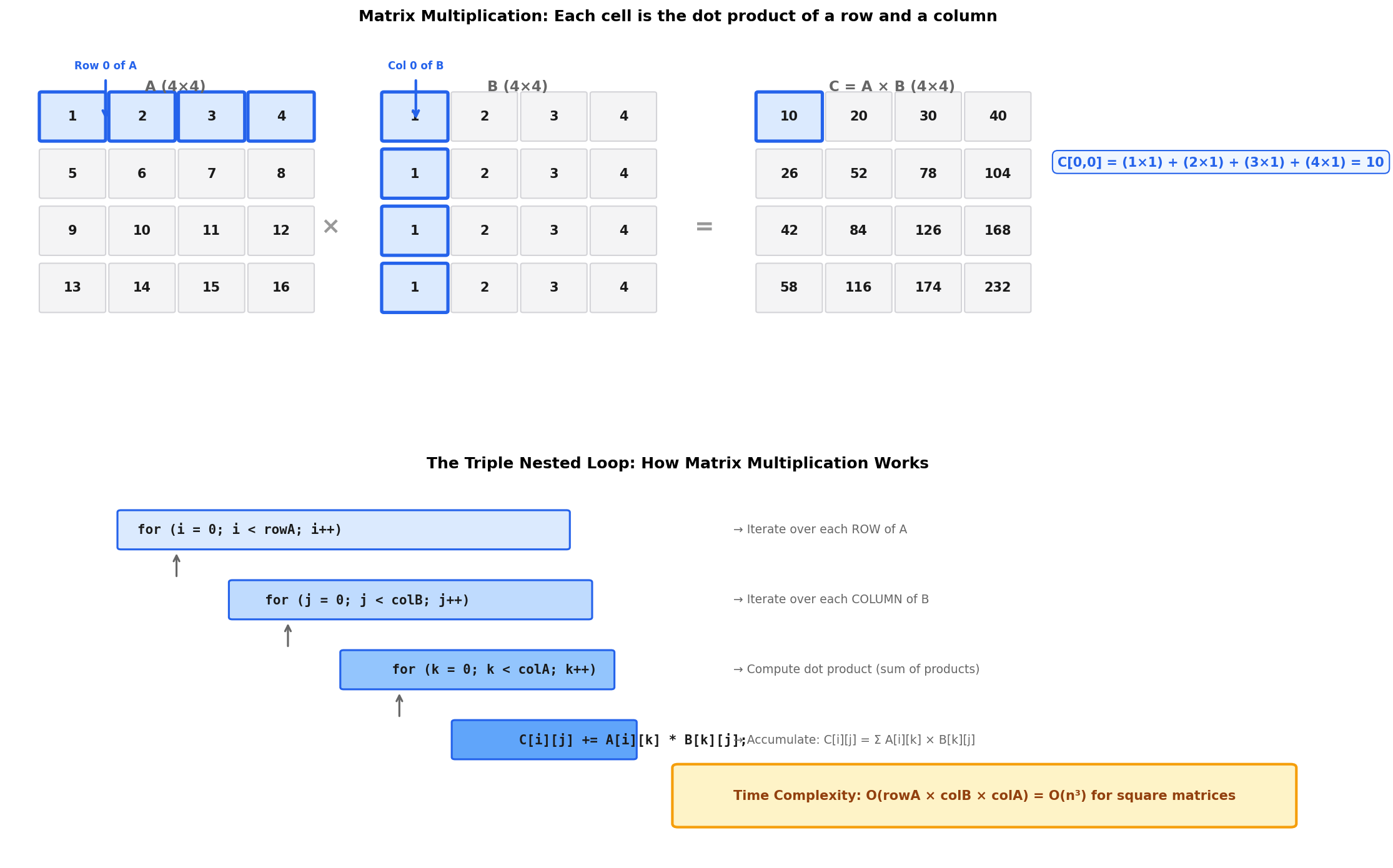
Top: Each cell in the result is the dot product of a row from the first matrix and a column from the second. Bottom: The triple nested loop that implements this.
Why This Works
Matrix multiplication is essentially a system of linear equations. Each row of $A$ defines a linear combination, and each column of $B$ provides the coefficients. The result $C$ encodes how these transformations compose.
The dimension rule ($A_{cols} = B_{rows}$) exists because the dot product requires equal-length vectors. You can’t dot a 4-element row with a 3-element column.
The C Code
Here is a clean implementation with proper memory management:
#include <stdio.h>;
#include <stdlib.h>;
/*
* Matrix Multiplication in C
* A[rowA][colA] × B[rowB][colB] = C[rowA][colB]
*
* Rule: colA MUST equal rowB for multiplication to be valid.
*/
#define ROW_A 4
#define COL_A 4
#define ROW_B 4
#define COL_B 4
// Function to multiply two matrices
// Returns a pointer to the resulting matrix C
int** multiply_matrices(int A[][COL_A], int B[][COL_B]);
int main() {
// Matrix A: 4 rows, 4 columns
int A[ROW_A][COL_A] = {
{1, 2, 3, 4},
{5, 6, 7, 8},
{9, 10, 11, 12},
{13, 14, 15, 16}
};
// Matrix B: 4 rows, 4 columns
// Note: COL_A (4) must equal ROW_B (4) ✓
int B[ROW_B][COL_B] = {
{1, 2, 3, 4},
{1, 2, 3, 4},
{1, 2, 3, 4},
{1, 2, 3, 4}
};
printf("Matrix A (%dx%d):\n", ROW_A, COL_A);
for (int i = 0; i < ROW_A; i++) {
for (int j = 0; j < COL_A; j++) {
printf("%d\t", A[i][j]);
}
printf("\n");
}
printf("\nMatrix B (%dx%d):\n", ROW_B, COL_B);
for (int i = 0; i < ROW_B; i++) {
for (int j = 0; j < COL_B; j++) {
printf("%d\t", B[i][j]);
}
printf("\n");
}
// Multiply!
int **C = multiply_matrices(A, B);
printf("\nResult C = A × B (%dx%d):\n", ROW_A, COL_B);
for (int i = 0; i < ROW_A; i++) {
for (int j = 0; j < COL_B; j++) {
printf("%d\t", C[i][j]);
}
printf("\n");
}
// CRITICAL: Free allocated memory to prevent memory leaks
for (int i = 0; i < ROW_A; i++) {
free(C[i]);
}
free(C);
return 0;
}
int** multiply_matrices(int A[][COL_A], int B[][COL_B]) {
// Allocate result matrix C[ROW_A][COL_B] on the heap
int **C = (int**)malloc(ROW_A * sizeof(int*));
for (int i = 0; i < ROW_A; i++) {
C[i] = (int*)malloc(COL_B * sizeof(int));
}
// Triple nested loop for matrix multiplication
for (int i = 0; i < ROW_A; i++) { // rows of A
for (int j = 0; j < COL_B; j++) { // columns of B
C[i][j] = 0; // initialize cell
// Compute dot product of row i of A and column j of B
for (int k = 0; k < COL_A; k++) { // COL_A == ROW_B
C[i][j] += A[i][k] * B[k][j];
}
}
}
return C;
}
Expected Output
Matrix A (4x4): 1 2 3 4 5 6 7 8 9 10 11 12 13 14 15 16 Matrix B (4x4): 1 2 3 4 1 2 3 4 1 2 3 4 1 2 3 4 Result C = A × B (4x4): 10 20 30 40 26 52 78 104 42 84 126 168 58 116 174 232
Step-by-Step Verification
Let’s verify one cell manually: $C_{0,0}$
\[C_{0,0} = A_{0,0} \cdot B_{0,0} + A_{0,1} \cdot B_{1,0} + A_{0,2} \cdot B_{2,0} + A_{0,3} \cdot B_{3,0}\] \[C_{0,0} = (1 \times 1) + (2 \times 1) + (3 \times 1) + (4 \times 1) = 1 + 2 + 3 + 4 = 10 \checkmark\]And $C_{1,2}$:
\[C_{1,2} = (5 \times 3) + (6 \times 3) + (7 \times 3) + (8 \times 3) = 15 + 18 + 21 + 24 = 78 \checkmark\]Why Use Pointers?
The function returns int** (a pointer to pointers) because C needs to allocate the result matrix dynamically on the heap. The stack can’t easily return 2D arrays.
Always free your memory! Forgetting free() causes a memory leak — your program gradually consumes more RAM until it crashes or slows down.
Common Mistakes
| Mistake | Why It Breaks | How to Fix |
|---|---|---|
| $A_{cols} \neq B_{rows}$ | Dimensions must match for multiplication | Verify COL_A == ROW_B before calling |
Forgetting to malloc |
Dangling pointer → crash | Always allocate before use |
| Not freeing memory | Memory leak | free() each row, then the array of pointers |
| Wrong loop order | Wrong result or out-of-bounds access | Follow i→j→k pattern |
| Integer overflow | Large matrix values exceed int range |
Use long long for big matrices |
Identity Matrix Verification
The identity matrix $I$ is the "1" of matrix multiplication.
\[A \times I = A\]// 4x4 Identity Matrix
int I[4][4] = {
{1, 0, 0, 0},
{0, 1, 0, 0},
{0, 0, 1, 0},
{0, 0, 0, 1}
};
// Multiply A × I and verify you get A back
Time Complexity
| Operation | Complexity | Explanation |
|---|---|---|
| Matrix Multiplication | $O(m \cdot k \cdot n)$ | Three nested loops: rows × inner dim × cols |
| Square matrices ($n \times n$) | $O(n^3)$ | Classic cubic complexity |
| Space | $O(m \cdot n)$ | Result matrix storage |
For large matrices, $O(n^3)$ is too slow. Real-world systems use:
- Strassen’s algorithm: $O(n^{2.81})$
- Coppersmith-Winograd: $O(n^{2.37})$ (theoretical)
- GPU parallelization: Process thousands of cells simultaneously
Real-World Applications
| Domain | How Matrix Multiplication is Used |
|---|---|
| Computer Graphics | 3D transformations: rotation, scaling, translation of objects |
| AI / Machine Learning | Neural networks are essentially layers of matrix operations |
| PageRank | Google’s original algorithm uses matrix iteration |
| Image Processing | Filters like blur and edge detection use matrix convolution |
| Physics Simulations | Solving systems of linear equations in engineering |
| Economics | Input-output models (Leontief matrix) |
Try It Yourself
- Identity check: Multiply any $4 \times 4$ matrix by the identity matrix. What do you notice? (Hint: $A \times I = A$)
- Dimension mismatch: What happens if you set
COL_A = 3andROW_B = 4? Does it compile? Does it run correctly? - Cache optimization: Can you optimize the code by transposing matrix $B$ first? (Hint: better cache locality!)
- Big matrices: Change the code to use
doubleinstead ofintand multiply two $100 \times 100$ random matrices. Time it withclock(). - Memory detective: Comment out the
free()calls, run the program in a loop 100,000 times, and watch your system’s memory usage withtopor Task Manager.