Factorial in C — From Counting to Infinity
Ever wonder how many ways you can arrange a deck of cards? Or how many different passwords you can make? That’s where factorial comes in — one of the most fundamental ideas in both math and programming.
What is Factorial?
The factorial of a non-negative integer $n$, written as $n!$, is the product of all positive integers from $1$ up to $n$.
\[n! = n \times (n-1) \times (n-2) \times \cdots \times 3 \times 2 \times 1\]A neat recursive way to think about it:
\[n! = n \times (n-1)!\]With the base case: $0! = 1$ and $1! = 1$.
Why does $0! = 1$?
It might seem weird, but think of it this way: there’s exactly one way to arrange zero items — do nothing! Mathematically, it also keeps the recursive formula $n! = n \times (n-1)!$ working for all $n \ge 1$.
Examples
| $n$ | $n!$ | Calculation |
|---|---|---|
| 0 | 1 | By definition |
| 1 | 1 | $1$ |
| 3 | 6 | $3 \times 2 \times 1$ |
| 5 | 120 | $5 \times 4 \times 3 \times 2 \times 1$ |
| 10 | 3,628,800 | $10 \times 9 \times \cdots \times 1$ |
| 15 | 1,307,674,368,000 | $15!$ |
| 20 | 2,432,902,008,176,640,000 | $20!$ |
Notice how fast factorial grows? $20!$ is already 2.4 quintillion — that’s why we need double or long long in C to handle large values.
Visual Intuition
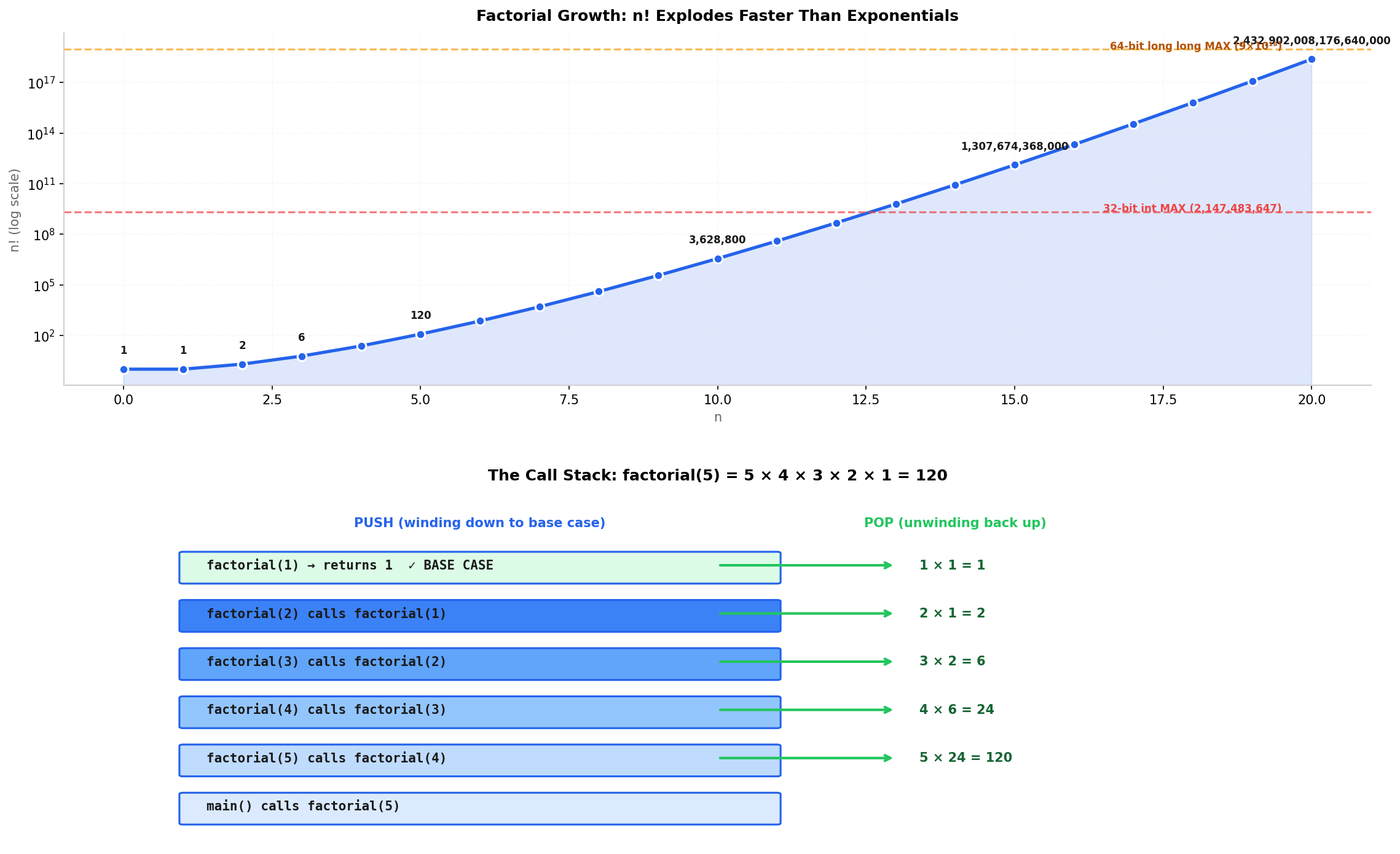
Top: Factorial grows faster than any exponential function. It exceeds 32-bit int at $n=13$ and 64-bit long long at $n=21$. Bottom: The call stack pushes frames down to the base case, then pops them back up, multiplying as it unwinds.
Why This Works
Factorial is the simplest example of recursion with a clear base case:
- The problem shrinks: $n!$ depends on $(n-1)!$, which is a smaller version of the same problem.
- The base case stops it: When $n \le 1$, we return 1 immediately. Without this, the function would call itself forever.
- The stack unwinds: Each frame waits for the one below it to return, then multiplies the result by its own $n$.
This pattern — divide, recurse, combine — appears in merge sort, quicksort, tree traversals, and countless other algorithms.
The Recursive C Code
Here’s a clean recursive implementation:
#include <stdio.h>
// Function declaration
double factorial(double n);
int main() {
double n = 20;
// Call the factorial function
double result = factorial(n);
printf("%.0f! = %.0f\n", n, result);
return 0;
}
// Recursive factorial: n! = n * (n-1)!
double factorial(double n) {
// Base case: stops the recursion
if (n <= 1) {
return 1;
}
// Recursive step: n! = n * (n-1)!
return n * factorial(n - 1);
}
Expected Output
20! = 2432902008176640000
How Recursion Works Here
When you call factorial(5), here’s what happens on the call stack:
PUSH (winding down): main() calls factorial(5) factorial(5) calls factorial(4) factorial(4) calls factorial(3) factorial(3) calls factorial(2) factorial(2) calls factorial(1) factorial(1) → returns 1 ✓ BASE CASE! POP (unwinding back up): factorial(2) returns 2 × 1 = 2 factorial(3) returns 3 × 2 = 6 factorial(4) returns 4 × 6 = 24 factorial(5) returns 5 × 24 = 120
Then the final result bubbles back to main(): 120.
⚠️ Watch Out for Stack Overflow!
If you call factorial(100000), you’ll hit a stack overflow — the call stack has limited space (typically ~1–8 MB). Each recursive call pushes a new frame, and 100,000 frames will crash your program.
For very large numbers, use an iterative approach instead.
Iterative Version (No Recursion)
#include <stdio.h>

int main() {
    int n = 20;
    unsigned long long result = 1;

    // Iterative approach using a for loop
    for (int i = 1; i <= n; i++) {
        result *= i;
    }

    printf("%d! = %llu\n", n, result);
    return 0;
}
Output:
20! = 2432902008176640000
Both versions give the same result, but the iterative one:
- Uses constant memory — no call stack growth
- Runs in $O(n)$ time with $O(1)$ space
- Can handle much larger $n$ before overflowing
Data Type Limits
| Type | Max Value | Highest $n!$ it can hold |
|---|---|---|
int (32-bit) |
2,147,483,647 | $12! = 479,001,600$ |
unsigned int |
4,294,967,295 | $12!$ |
long long (64-bit) |
9,223,372,036,854,775,807 | $20!$ |
unsigned long long |
18,446,744,073,709,551,615 | $20!$ |
double |
~$1.8 \times 10^{308}$ | $170!$ (loses integer precision after $15!$) |
Pro tip: Use
unsigned long longfor exact integer results up to $20!$. Usedoubleonly when you need larger approximate values and don’t care about perfect precision.
Real-World Uses
| Domain | Application |
|---|---|
| Combinatorics | How many ways to arrange $n$ items? $n!$ permutations |
| Probability | Calculating combinations $C(n,k) = \frac{n!}{k!(n-k)!}$ |
| Taylor Series | Approximating $e^x$, $\sin(x)$, $\cos(x)$ using factorial denominators |
| Computer Graphics | Shading algorithms and Bernstein polynomials |
| Cryptography | Counting possible keys and password spaces |
| Statistical Mechanics | Entropy calculations in physics |
The Taylor Series Connection
Factorials appear in the denominators of Taylor series, letting us approximate transcendental functions with polynomials:
\[e^x = \sum_{n=0}^{\infty} \frac{x^n}{n!} = 1 + x + \frac{x^2}{2!} + \frac{x^3}{3!} + \cdots\] \[\sin(x) = \sum_{n=0}^{\infty} \frac{(-1)^n x^{2n+1}}{(2n+1)!} = x - \frac{x^3}{3!} + \frac{x^5}{5!} - \cdots\]This is how calculators compute these functions — they sum the first 10–20 terms!
Try It Yourself
- Scale test: Modify the code to compute $10!$, $15!$, and $20!$. Verify the values match the table above.
- Error handling: What happens if you input a negative number? Add a check:
if (n < 0) { printf("Factorial undefined for negatives!\n"); return -1; } - While loop: Rewrite the iterative version using a
whileloop instead of aforloop. - Type detective: Change
doubletointand compute13!. What happens? Why? (Hint: integer overflow) - Taylor approximation: Write a program that computes $e^1$ using the Taylor series $e^x = \sum \frac{x^n}{n!}$. Sum the first 15 terms and compare with
exp(1.0)from<math.h>. - Permutation calculator: Write a program that asks for $n$ and $k$, then computes $P(n,k) = \frac{n!}{(n-k)!}$ — the number of ways to arrange $k$ items from a set of $n$.