Palindromic Number in C — The Mirror Test
A palindromic number is a number that reads the same forwards and backwards — like 16461, 12321, or 7. It has reflectional symmetry across a vertical axis: the first digit matches the last, the second matches the second-to-last, and so on.
The concept extends beyond numbers. A word like rotor or tenet is also a palindrome. In fact, the term comes from the Greek palíndromos — “running back again.”
The Mirror Test
The simplest way to check if a number is palindromic? Reverse its digits and compare.
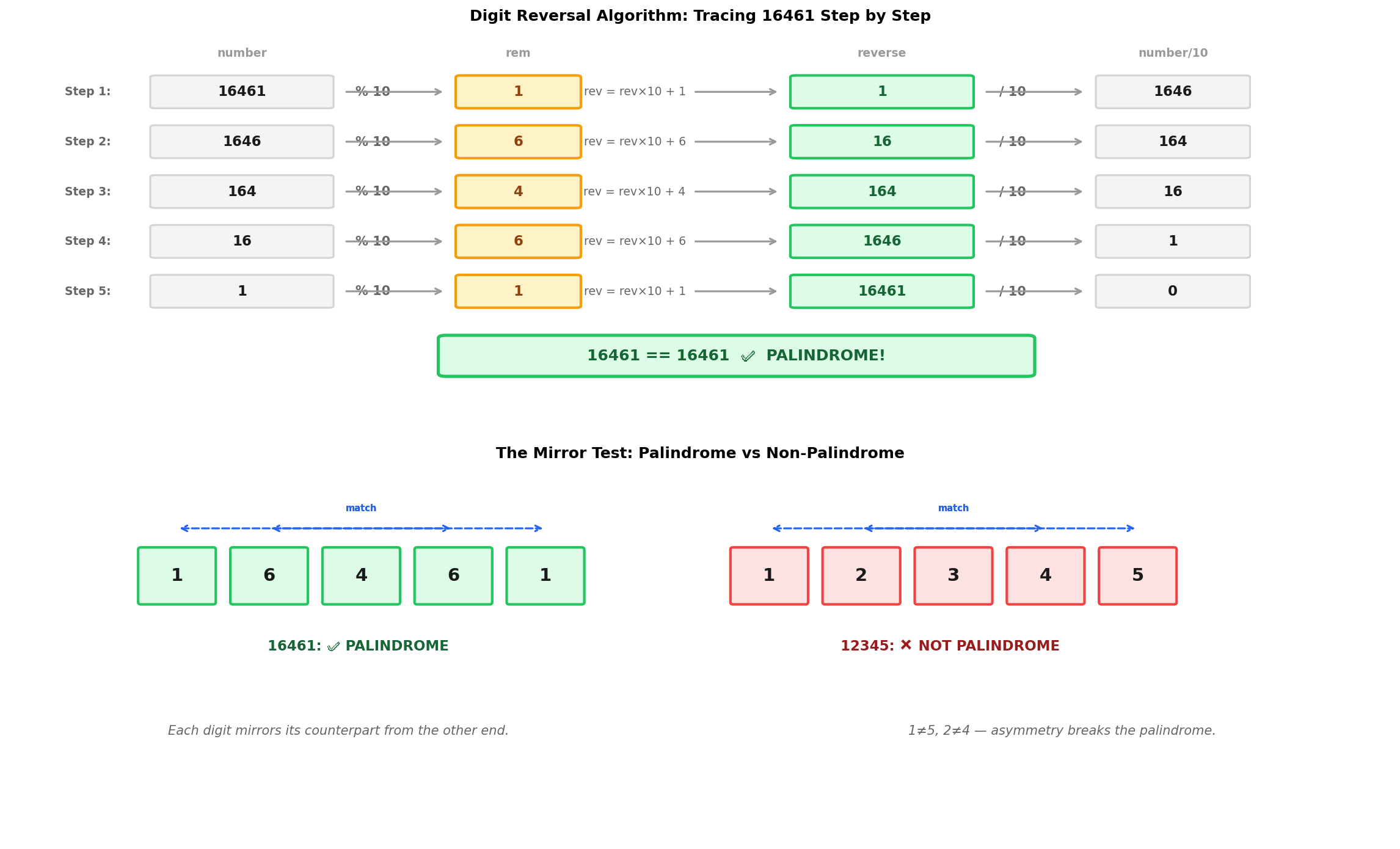
Top: The digit-reversal algorithm extracts each digit, builds the reverse, and compares. Bottom: A palindrome mirrors perfectly; a non-palindrome breaks the symmetry.
Why This Works
Our algorithm relies on two elementary operations:
number % 10— the modulo operator extracts the last digitnumber / 10— integer division chops off the last digit
By repeating these two operations in a while loop, we peel off digits one by one (like layers of an onion) and build the reversed number:
| Operation | number |
number % 10 |
number / 10 |
|---|---|---|---|
| Start | 16461 | 1 | 1646 |
| After 1st | 1646 | 6 | 164 |
| After 2nd | 164 | 4 | 16 |
| After 3rd | 16 | 6 | 1 |
| After 4th | 1 | 1 | 0 |
When number becomes 0, we’ve extracted every digit. The reversed number is built by reverse = reverse × 10 + digit at each step.
Step-by-Step Trace
Let’s trace num = 16461 through the algorithm:
| Iteration | number |
rem = number % 10 |
reverse = reverse×10 + rem |
number = number / 10 |
|---|---|---|---|---|
| 1 | 16461 | 1 | 0×10 + 1 = 1 | 1646 |
| 2 | 1646 | 6 | 1×10 + 6 = 16 | 164 |
| 3 | 164 | 4 | 16×10 + 4 = 164 | 16 |
| 4 | 16 | 6 | 164×10 + 6 = 1646 | 1 |
| 5 | 1 | 1 | 1646×10 + 1 = 16461 | 0 |
Final check: origin (16461) == reverse (16461) → ✅ Palindrome!
Now trace num = 12345:
| Iteration | number |
rem |
reverse |
number / 10 |
|---|---|---|---|---|
| 1 | 12345 | 5 | 5 | 1234 |
| 2 | 1234 | 4 | 54 | 123 |
| … | … | … | … | … |
| 5 | 1 | 1 | 54321 | 0 |
Final check: origin (12345) == reverse (54321) → ❌ Not a palindrome!
The C Code
Here is a clean implementation with proper error handling:
#include <stdio.h>

// Returns 1 if palindrome, 0 otherwise
int is_palindrome(int number);

int main() {
    int num;

    printf("Enter a number to check: ");
    scanf("%d", &num);

    // Error handling: negative numbers
    if (num < 0) {
        printf("Negative numbers are not considered palindromic in this implementation.\n");
        return 1;
    }

    if (is_palindrome(num)) {
        printf("✅ %d is a palindromic number!\n", num);
    } else {
        printf("❌ %d is NOT a palindromic number.\n", num);
    }

    return 0;
}

int is_palindrome(int number) {
    // Save the original number for comparison
    int original = number;
    int reverse = 0;

    // Reverse the number digit by digit
    while (number != 0) {
        int remainder = number % 10;        // Extract last digit
        reverse = reverse * 10 + remainder; // Append to reverse
        number = number / 10;               // Remove last digit
    }

    // Palindrome if reversed equals original
    return (original == reverse);
}
Expected Output
Enter a number to check: 16461 ✅ 16461 is a palindromic number! Enter a number to check: 12345 ❌ 12345 is NOT a palindromic number. Enter a number to check: 7 ✅ 7 is a palindromic number!
How the Reversal Works
The key insight is place-value arithmetic. Each time we do reverse = reverse × 10 + digit, we shift all existing digits left by one place (the × 10) and insert the new digit at the ones place.
reverse = 0 reverse = 0×10 + 1 = 1 // digit: 1 reverse = 1×10 + 6 = 16 // digit: 6 reverse = 16×10 + 4 = 164 // digit: 4 reverse = 164×10 + 6 = 1646 // digit: 6 reverse = 1646×10 + 1 = 16461 // digit: 1
This is exactly how you’d reverse a number by hand — just automated.
Common Pitfalls
| Mistake | Why It Breaks | Fix |
|---|---|---|
Forgetting to save original |
You compare reverse with number, but number is now 0 |
Store original = number before the loop |
Using number % 10 on negatives |
Negative remainders in C (-123 % 10 = -3) | Check number < 0 first or use abs() |
| Integer overflow | reverse * 10 can exceed INT_MAX for large inputs |
Use long long for 10+ digit numbers |
| Single-digit numbers | Some forget that 0–9 are palindromes | The algorithm handles this correctly (0→0, 7→7) |
Alternative: The Two-Pointer Approach
Instead of reversing the entire number, you can compare digits from both ends:
#include <stdio.h>
#include <math.h>

int is_palindrome_two_pointer(int number) {
    if (number < 0) return 0;
    if (number < 10) return 1;  // Single digit is always palindrome

    // Count digits
    int digits = 0;
    int temp = number;
    while (temp != 0) {
        digits++;
        temp /= 10;
    }

    // Compare outer digits, then move inward
    int left = digits - 1;
    int right = 0;

    while (left > right) {
        int left_digit = (number / (int)pow(10, left)) % 10;
        int right_digit = (number / (int)pow(10, right)) % 10;

        if (left_digit != right_digit) {
            return 0;  // Mismatch found
        }

        left--;
        right++;
    }

    return 1;
}
The reversal method is simpler and faster for most cases. The two-pointer approach shines when you cannot modify or copy the number (e.g., in a read-only memory context).
Real-World Connections
| Domain | Application |
|---|---|
| Genetics | Palindromic DNA sequences (e.g., restriction enzyme sites) read the same on complementary strands |
| Number Theory | Palindromic primes (e.g., 131, 151, 181) and their distribution properties |
| Date Calculations | 02/02/2020 was a palindromic date in both DD/MM/YYYY and MM/DD/YYYY formats |
| Error Detection | Certain checksum algorithms exploit palindromic patterns for validation |
| Puzzles & Competitions | Project Euler #4: largest palindrome from the product of two 3-digit numbers = 906609 |
| Linguistics | Palindrome detection in DNA sequencing, poetry analysis, and word games |
Mathematical Definition (Formal)
For the curious, a number $n > 0$ in base $b \ge 2$ with digits $a_0, a_1, \ldots, a_k$:
\[n = \sum_{i=0}^{k} a_i b^i \quad \text{where } 0 \le a_i < b \text{ and } a_k \ne 0\]Then $n$ is palindromic if and only if:
\[a_i = a_{k-i} \quad \text{for all } i \in \{0, 1, \ldots, k\}\]Zero is palindromic by definition in any base.
Try It Yourself
- Project Euler #4: What is the largest palindromic number made from the product of two 3-digit numbers? (Answer: 906609 = 913 × 993)
- Binary palindromes: Modify the code to check palindromes in base-2. Is 5 (
101in binary) a palindrome? Is 6 (110)? - No reversal: Can you check palindromicity without reversing the number or converting it to a string? (Hint: compare the first and last digits mathematically.)
- Longest palindrome: Write a program that finds the longest palindromic substring in a given string. (This is a classic interview problem!)
- Palindrome generator: Write a program that generates all palindromic numbers between 1 and 10,000.
- Overflow hunter: What happens if you input
2147483647(INT_MAX)? Does the reversal overflow? Fix it by usinglong long.